

Obsession
Bear, I love you so so so so so much. I don’t think I could live without you.

If this article gets cut off in email, please keep reading on Substack!
Obsession was released on May 15th, 2026. It instantly became a phenomenon. It’s not exactly a summer movie, at least not in the way other films I’ve covered are, but it’s undeniably a summer 2026 blockbuster that’s kept audiences talking for months. I was a little late to the Obsession party. I saw it in theaters for the first time a few weeks ago. But when I did arrive, I was as disgusted, terrified, and captivated as everyone else.
What I really love about Obsession is that it’s an independent film, reportedly made on a $750,000 budget that went on to make $447 million at the box office. I hope Hollywood learns the right lesson from this; it is worth it to give beginner filmmakers a chance. Though it’s not only about how much money the movie has made, but about the way it’s brought moviegoers together. My social media feeds are full of analyses, theories, and newly spotted easter eggs, and to me that’s what cinema is all about: community. This week I’m doing my best to decode the movie from my perspective.
Since this newsletter is so long, here’s a table of contents:
The One Wish Willow: Control & Selfishness
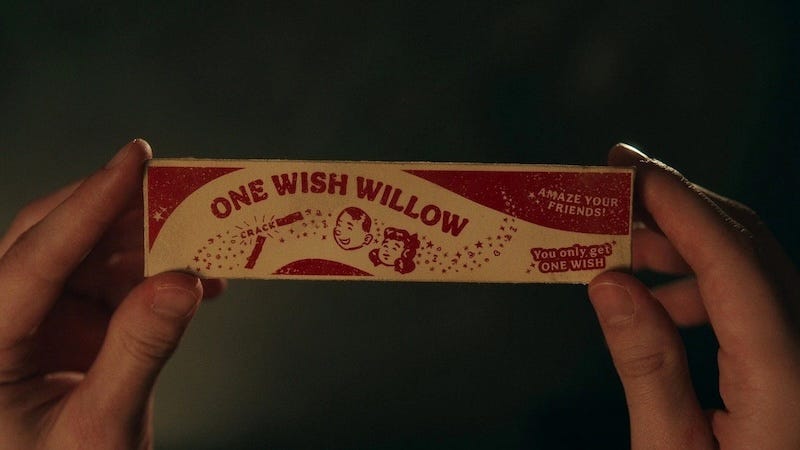
The moment we meet Bear at the beginning of Obsession, he has one motive: to tell his friend Nikki how he feels, hoping she has the same romantic feelings for him. From that opening monologue, this is what we learn about Bear: he likes how Nikki treats him and how she makes him feel. He praises her for what she does for him, like being a shoulder to cry on when his grandmother died, and expresses fears that if she knows he likes her and doesn’t feel the same way, he might lose her. Never once does he mention what he loves about Nikki or what makes her special. It’s impressive how much we’re told about Bear so early in the film; he is more concerned with himself than he is with the girl he claims to love. It’s not unusual to be afraid to tell someone you like them. Human beings are wired to fear rejection. However, the way Bear tries to micromanage the situation, like he needs to guarantee Nikki likes him back before telling her how he feels, leads to the main theme in Obsession: control.
We know that Nikki is spiritual and likely believes there are dark forces in the world that she needs to protect herself from. But Nikki loses her crystal necklace at the beginning of the film and then later gives her family Tiger’s Eye stone to Bear, transferring its protective powers to him. With nothing keeping her safe, she’s susceptible to control, and Bear’s wish is free to transform her into the demon-like being she becomes. It’s unclear what really happens to Nikki when Bear uses the One Wish Willow on her. Director Curry Barker says the film is not about possession, but it’s evident that something has overtaken Nikki, stealing her autonomy.
The way Bear phrases his wish is vital to the story. “I wish Nikki Freeman were in love with me” or “I wish Nikki Freeman liked me back” feel like logical wishes. But Bear says something more sinister. “I wish Nikki Freeman loved me more than anyone in the world.” With these words, he ensures that he comes first; before her family and other friends, and while he did specify “anyone,” not “anything,” I think the words are synonymous in this case. When Nikki gives Bear the Tiger’s Eye, she also tells him that it brings confidence. She wants him to use it to make his dreams of being a food critic come true. But before Bear’s wish, Nikki has dreams of her own. She’s writing a book, and the family stone was meant to give her confidence to publish it and build a writing career. By giving the Tiger’s Eye to Bear, it’s like she’s handing over her dreams. She is now consumed with him because she loves him above all else, which has led many fans online to feel like he’s taking advantage of her. This is basically told to him when he later calls the company behind the One Wish Willow. When he asks if Nikki’s love for him is real, the phone operator tells him, “Just because you chose this for her doesn’t make it less real.” After all, if the real Nikki has no control over herself anymore and can’t make decisions for herself, can she really agree to be in this relationship with Bear?
Nikki’s behavior changes immediately after Bear makes his wish. However, Bear, not truly believing a gimmick from a magic shop would work, assumes she’s just drunk from their night out. Nikki confesses her dad is dying (a lie), and Bear then believes that is the cause of her instability. He later has multiple conversations with Ian about how Nikki is not herself, and they question if she’s started using drugs again. “Mental breakdown” is how Bear describes Nikki’s recent behavior before saying “she needs serious help” and calling her actions “psychotic.” It’s Ian who later suggests to Bear that by continuing his relationship with Nikki, he could be taking advantage of someone who’s clearly in a fragile state. Someone who really loves Nikki would understand this perspective and would have called off any chance of a relationship the first time she broke down about her father. Learning she lied about it should have made him even more reluctant to be with her. But he proceeds.
After their dinner date, where the lie comes out, and Nikki has a manic reaction to Bear finding out the truth, Bear turns a blind eye. The two go back to his house and have sex. It is an extremely disturbing scene because while the entity who’s obsessed with Bear is enjoying it, the blank look on her face shows us the real Nikki is inside, and she has not consented to this. But this isn’t the only time the real Nikki emerges and expresses to Bear how exploited she feels. The night after Bear makes his wish, which leads to Nikki coming over to his house and making out with him, Nikki appears at his door. She claims she was on drugs and drunk the previous night, and an unsettling conversation ensues:
Nikki: “I’m not saying that you took advantage of me.
Bear: “Nikki, I didn’t know you were on drugs.
Nikki: That’s what I’m saying; I’m not saying that.
Bear: Not saying what?
Nikki: You took advantage of me.
That phrase suggests that while Nikki is trying to tell Bear she doesn’t think he took advantage of her, the real Nikki within probably does think that. I find her tone of voice when she says this line to be very telling. Within Nikki’s body, there’s a constant fight between the real her and who Bear wished for, which is why there’s a lot of back and forth in what she says. But when Nikki murders their friend Sarah in a jealous rage, the real Nikki seems to clarify that she finds Bear responsible for Sarah’s death. “I’m so sorry you had to see that, baby,” she tells him. That’s the entity speaking. “But it is kind of your fault. Just remember that you wanted this.” That’s the real Nikki coming through. She later tells him, “This is all your fault. Sarah’s your fault. You wanted this. You wished for this.”

No matter how much Bear tries to pretend he plays no role in what’s happened to Nikki, she wants him to know that he is responsible. For most of the film, he’s in denial that his wish actually worked. He believes that Nikki really does have intense feelings for him seemingly out of nowhere. Logically, it’s understandable, but the thing with Obsession is, it doesn’t really matter as much that Bear caused Nikki’s behavior; what matters is how Bear deals with it. As we learned at the start of the film, Bear doesn’t care about Nikki as much as he cares about his own feelings. We learn he’s pretty selfish the minute he snaps the One Wish Willow and makes his wish, not only because of the wish he makes but because the One Wish Willow wasn’t supposed to be for him. When Nikki loses her crystal necklace, Bear goes to the magic shop with the intention of buying her a new one–whether this was out of love or a ploy to make her love him back is up for debate. When he can’t decide which one to get her, he buys her the One Wish Willow instead. He can’t work up the courage to give it to her, so instead he uses it for himself. It’s quite metaphorical. Bear takes something that technically belonged to Nikki, much like he takes her autonomy with his wish.
I know this was not exactly his intention when he made the wish, but Barker was sure to include a scene where Bear has his suspicions upon buying the One Wish Willow. The cashier tells him that people who use it often come back to the store and complain. Bear’s response? “Cause they’re mad cause it doesn’t work or it does work and it like ruins their lives.” But Bear throws these concerns out his car window when he decides to use the One Wish Willow to get what he wants. It ultimately does ruin Bear’s life, which is way more upsetting to him than the fact that he ruined Nikki’s life too. The first night, when Nikki kisses Bear, there’s a moment where she jumps back. Bear responds, “You made me feel like I did something you didn’t like.” He doesn’t ask if she’s okay or ask if he did do something she didn’t like; he immediately points the finger at her, like she is responsible for his emotions.
His selfishness goes hand in hand with his inability to take responsibility for his actions. After all, it’s about an hour into the film when Bear finally accepts Nikki isn’t on drugs and she’s not going through a tumultuous period in her life. His wish made her like this, and he had more than enough opportunities to see that he caused it. During the dinner scene, when she gives him the Tiger’s Eye, he asks her, “Do you love me more than anyone in the world?” just like he’d wished. Of course she responds, “Yes, more than anyone.” He’d also already done an internet search the night he made the wish. While you shouldn’t believe everything you see online, there were a lot of cases of the One Wish Willow working. According to Thredit user Berenstain_Bear_Facts, their mom was ugly her whole life, but after using the One Wish Willow, now she’s beautiful!
“I can, I can, I can. I'll be anything you want me to be,”-Nikki, Obsession.
When he calls One Wish Willow, his initial question is if he can alter his wish, not cancel his wish. He doesn’t want to free his friend from what he’s done; he still wants her to be in love with him; he just doesn’t want her to be obsessed. The sad reality is, Bear doesn’t even seem upset that the Nikki he once knew is gone, because it was never really about her. He doesn’t mourn the times they had together or all the qualities that made her so lovable to begin with. He’s willing to overlook all the red flags to stay in the relationship with her even though it’s not the person he fell for. There’s another moment in the film when Nikki’s body is asleep, giving the real Nikki a chance to speak. She desperately asks Bear to kill her, but Bear has no sympathy. He responds, “What would be so bad about being with me?” Nikki’s request isn’t personal, but he makes it about himself. She must be suffering so badly to choose death over living in her body. But Bear takes it as rejection.
It’s not until Sarah’s murder that Bear really tries to cancel his wish. He buys another One Wish Willow and tries to wish that Nikki will only like him as a friend. Of course, each person only gets to wish on a One Wish Willow once, so it doesn’t work. His only option, besides death, is to bring it to his friend Ian and have him make a wish. Here’s where he switches up again. He doesn’t ask Ian to make that wish for him, but to wish that he gets another wish. We don’t know what he would have wished for if Ian had followed his instructions instead of wishing for a billion dollars, but we can assume he may have still wanted to be with Nikki, maintaining his control over her.
Even when he overdoses on his grandma’s pills, he intends to free himself, not the girl he’s held prisoner. He has a moment of regret too, as if, after everything, he’s still not ready to end his relationship with Nikki. But soon we hear the snap of his extra One Wish Willow. While she seemingly wishes that he’ll love her as much as she loves him, Bear soon dies. The wish is canceled, but Nikki is alone to deal with multiple dead bodies and the trauma of what has happened to her. Bear is off the hook, and the real Nikki is left to deal with the mess he made. That’s quite symbolic.
Freaky Nikki (& The Real Nikki Within)
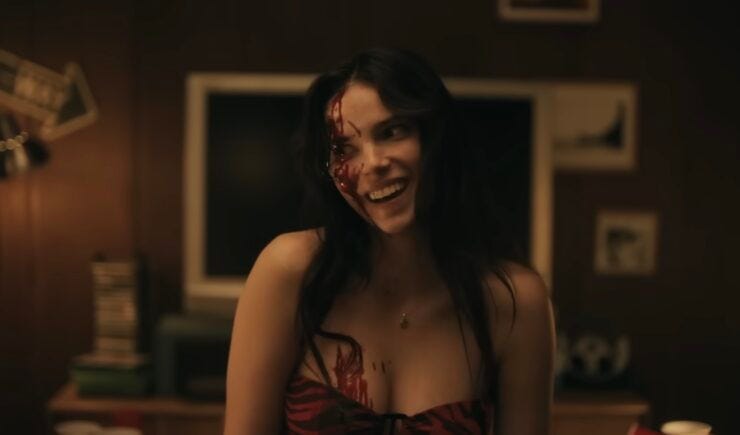
At the beginning of Obsession, Ian suggests that Bear flirt with Nikki by calling her “Freaky Nikki,” the nickname bullies called her when she was younger. He’s hesitant but does it in the spur of the moment, and it obviously triggers her. The nickname’s never really explained, though. Was she considered freaky because she’s into supernatural stuff like crystals and magic? Was she just an outcast in school so everyone thought she was a freak? All we know is that toward the end of the film, Nikki tells Bear, “I’m your Freaky Nikki.” My interpretation is that Bear may have summoned this side of Nikki when he triggered her, and then his wish allowed Freaky Nikki to take over. While real Nikki is kind and likable and grounded, Freaky Nikki is erratic, emotionally unstable, and, of course, obsessive. She shows intense attraction toward Bear, freaks out when he wants to go to boys’ night without her, and in the end turns murderous. Freaky Nikki’s also incredibly jealous of Sarah. Everyone seems to know that Sarah likes Bear, and the reason it’s so threatening is that Bear and Sarah seem to have a genuine connection.

When Nikki ultimately does show up to boys’ night with Bear, she’s displeased when a lighthearted game leads Bear to have to kiss the person to his left. Sarah’s the one sitting on his left until an unhinged Nikki drags her chair away and takes her spot. While Barker says he directed Nikki actress Inde Navarrette to play a jealous girlfriend, many online have compared Nikki’s behavior to their own experiences with BPD, especially the back and forth between Freaky Nikki and real Nikki. Among the many clues that the real Nikki is still inside is a scene where Nikki wakes up in the middle of the night and tells Bear, “I don’t like my dreams.” I can imagine the real Nikki is being haunted by obsessive images that this entity is producing. Then, when Bear calls the company behind One Wish Willow, the phone operator confirms that Nikki is still here, like she’s in some void within her own mind. He plays a recording of a blood-curdling scream, and we know Nikki is conscious of what’s happening to her.
The thing is, while we see the real Nikki in the beginning of the film, I don’t think we ever really know who she is because we’re seeing her through Bear’s idealized perspective. To Bear, she is perfect. When Bear and Nikki first start dating, there’s a montage that shows their relationship like a supercut of the honeymoon phase. But this doesn’t last long. When Freaky Nikki takes over, it’s a metaphor. Bear is extremely disturbed and turned off when Nikki isn’t perfect anymore. Yes, her behavior is beyond what the typical flawed human being exhibits, but that’s because it’s an exaggeration. Bear has built up the perfect image of Nikki in his head, and when she can’t live up to that, his love for her fades. He talks about how she was there for him when his grandmother passed away, but when she’s upset the first night at his house, he doesn’t know how to console her. He pulls away because he can’t handle that she’s a real person instead of the fantasy version he created.
Nikki & Her Reflection
What a lot of fans have been theorizing on is that maybe the real Nikki doesn’t spontaneously come out, but something triggers her to regain control. The trigger is Nikki seeing her own face. The first time Nikki starts acting weird, right after Bear makes his wish, she seemingly sees her reflection in his car’s side mirror and then bounces back to herself. Later, when she’s kissing Bear, it looks like she sees her reflection in his eyes, causing her to jump back in horror. It’s the line she says afterward that seemingly confirms this theory: “I thought I saw something.”
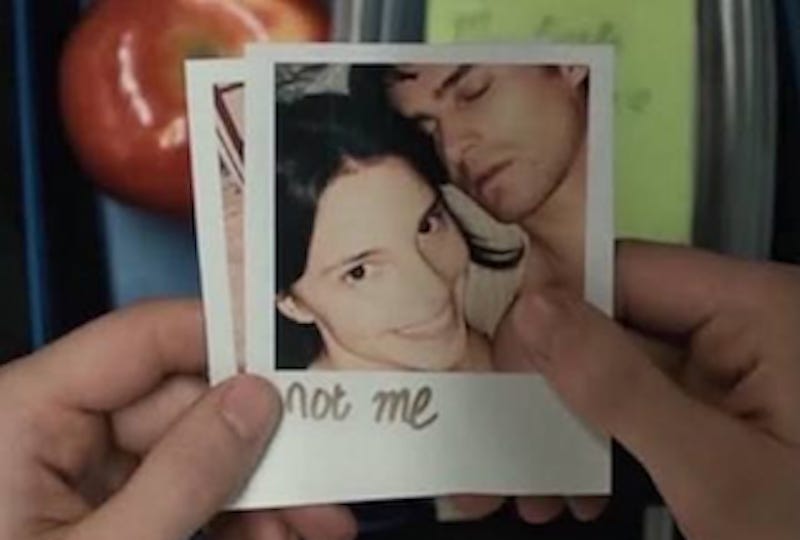
In the film’s eeriest scene, Nikki scurries past Bear’s bed holding a flower vase over her face. Why? Perhaps the entity didn’t want Nikki seeing herself in Bear’s bedroom mirror. But Nikki sees herself again in a polaroid picture that Freaky Nikki took with Bear. When she packs his lunch, she puts the photo with his sandwich. The phrase “Not me” is written beneath it, like a warning to Bear that he’s not in a relationship with the real Nikki. And though the real Nikki seems long gone by the party scene, she does see herself in Bear’s eyes again, falling back once more and screaming “It’s not me.” When no one does anything to help her, she bashes herself in the face with a beer bottle like she’s trying to kill herself or the entity.
The Cat Theory
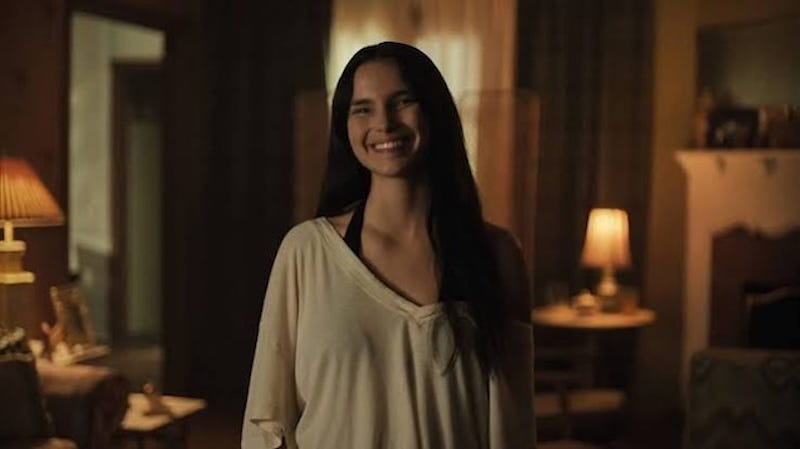
Possibly more compelling than the reflection theory is the cat theory. It feels both ridiculous and so convincing that it almost has to be true. Bear’s cat Sandy dies at the start of Obsession after she gets into Bear’s deceased grandmother’s medicine cabinet and eats a bottle of pills. The theory goes that when Bear makes his wish, Nikki becomes possessed by his dead cat. After all, who could love you more than anyone in the world like your pet could? After he makes his wish, Nikki becomes preoccupied with Sandy. She keeps bringing her up, even telling Bear, “I did just lose my cat,” as an excuse for why he shouldn’t leave her alone at night. This doesn’t make any sense, as Bear is the one who lost his cat, but it’s as if Nikki can’t stop mentioning Sandy. Some people even think Nikki saying her dad is dying foreshadows Bear’s own death because Bear was like Sandy’s father. But what feels especially cat-like is how Nikki is obsessed with Bear’s scent. She mentions it when she walks into his house for the first time, praising how it smells like him, and then again when she’s wearing his sweater. “It smells like you,” she says. It’s reminiscent of a pet being comforted by its owner’s scent.
In the same scene, Nikki watches Bear sleep from the corner of the room as a cat might do. There are also more disturbing things Nikki does, like taking Sandy’s dead body out of the garbage bag and putting her in the center of a shrine, and later cooking Sandy into a sandwich that Bear eats at work. In one scene, Nikki pees her pants and throws up on herself as she stands by the door waiting for Bear to come home. Many have compared this to what a pet might do when their owner is away, possibly from separation anxiety or out of defiance. Others even claim there was cat food in her throw-up. Most disturbingly, after murdering Sarah, she brings the dead body back in the house like a cat who’s killed an animal outside and then brings it in as a gift for its owner. This theory is extremely far-fetched, but I’d like to hear Barker’s take on it.
Is Bear The Movie’s Villain?
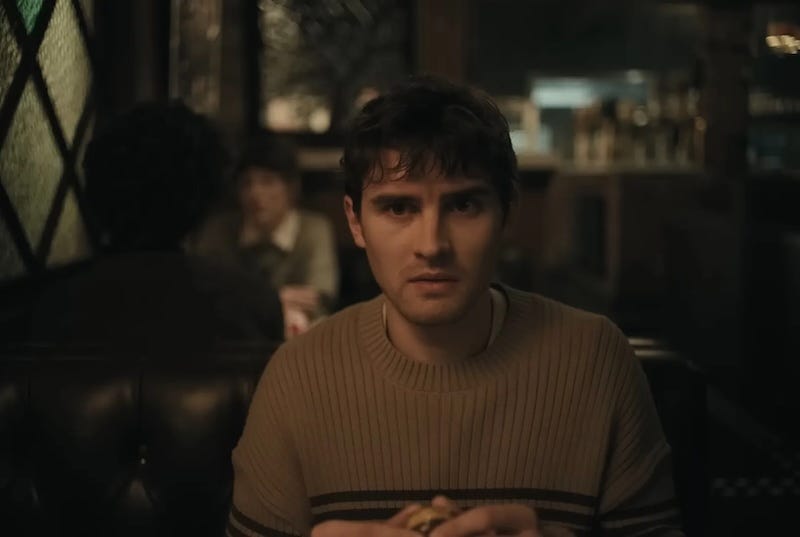
My Obsession take might be controversial, but I do think, like all media, there is nuance to this story. Bear’s issues are all subconscious, and I’d argue he didn’t do any of this to Nikki intentionally. I saw a pretty out-there theory on TikTok claiming that Bear is a serial killer. I think the top comment on the post pretty much sums up his character. User Lo responded, “People are going too far to make him [absolutely] evil. The point is that he is a regular, selfish guy and the line is thin for many people to become bad people.” She hit the nail on the head. Bear’s poorly worded wish was a way for him to have his feelings reciprocated, and no one is a villain for wanting the person they like to like them back. Who doesn’t want that? When his wish works, he expresses completely normal human excitement over getting to be with Nikki like he always wanted. Of course, his irresponsibility and selfishness were at play, and Nikki had to suffer because of that.
That’s why the line is thin. He didn’t wish for anything bad to happen to Nikki. He never intended for her to become “possessed” by this entity, but because he was only thinking of himself, he created a nightmare. In fact, in the real world, historically, a lot of harm has been done when people act from a place of selfishness. It reminds me of the villains of Disney movies. In most of Disney’s fairytales, there’s an evil, magical creature wreaking havoc and spreading curses. Then in Beauty and the Beast, the villain is a vain, arrogant village man. But watch the movie, and you’ll see that he’s just as dangerous as the rest.
I will give Bear credit for trying to do the right thing at the start of the film. He doesn’t want to go into Nikki’s house or invite her back to his when he believes that she’s drunk because he doesn’t want to take advantage of her. He only caves when Nikki breaks down about her father. He can easily be seen as a good friend for letting her stay over at his house so she doesn’t have to be alone. He also gives his bed to Nikki, not wanting to sleep in it with her–he shouldn’t have caved on this one given her mental state. At least in the beginning, Bear seems to have a moral compass.
“We have to take space from each other, Nikki! It's normal for couples to have some fucking space from each other,”-Bear, Obsession.
While it is Bear who summoned this dark entity inside of Nikki, it still has power over him in many ways. He can’t go anywhere without her because she’ll freak out; she threatens to harm herself if he leaves her, and she regularly emotionally manipulates him. Bear seems terrified of what would happen if he did leave the relationship. Sarah picks up on this when she tells Bear that Nikki is taking advantage of him. Of course, she doesn’t know about the wish, but she does see how Bear is not in full control.
I think the prescription bottles in Bear’s medicine cabinet could signify that he also struggles with his mental health. They might have belonged to his grandma, but there’s no reason he needed to keep them after she passed away. Was he self-medicating? Could he have left a bottle open after using it, and that’s how his cat got into it? His own mental state could also be the thing that leads him into such a toxic and codependent dynamic with Nikki. A mentally healthy person wouldn’t stay in a relationship like that, but Bear doesn’t seem to know the difference between love and obsession, at least not until the very end.

Where I do want to refocus some of the responsibility is on the company behind the One Wish Willow and the magic store that sells it. Bear isn’t the first one to have an unfortunate experience with the willow. Why else would the phone operator know, without Bear telling him, that he wants to cancel his wish? The store cashier also tells Bear that there are warnings all over the One Wish Willow box about its capabilities. But I don’t think warnings are enough. I think the company should stop producing something that is actively harming people, and the store should never have been selling it after so many complaints. It feels like the company preys on people like Bear, people who are desperate. I also think Ian is a villain in his own way. We learn that Ian and Nikki have been hooking up on and off behind Bear’s back. Ian knew how much his friend liked Nikki and was even trying to help him tell her how he felt, but the whole time he knew Nikki wasn’t interested in him because they were hooking up. That is a pretty awful friend.
Another area I think some viewers have gone too far is suggesting Bear is being selfish for not wanting to kill Nikki or himself. In a way, he is because he doesn’t want to end his relationship with Nikki despite Nikki being trapped. However, I also find it completely logical to not want to commit murder or end your own life. Back to the company, why would they ever sell something that requires people to die in order to break their wish? None of this is to say Bear was innocent. He was a perpetrator as much as he was a victim, but his choices, intentional or not, led him down the path to villainhood.
Amazing writing and analysis!
I haven’t seen this one yet but I loved your in-depth analysis!